
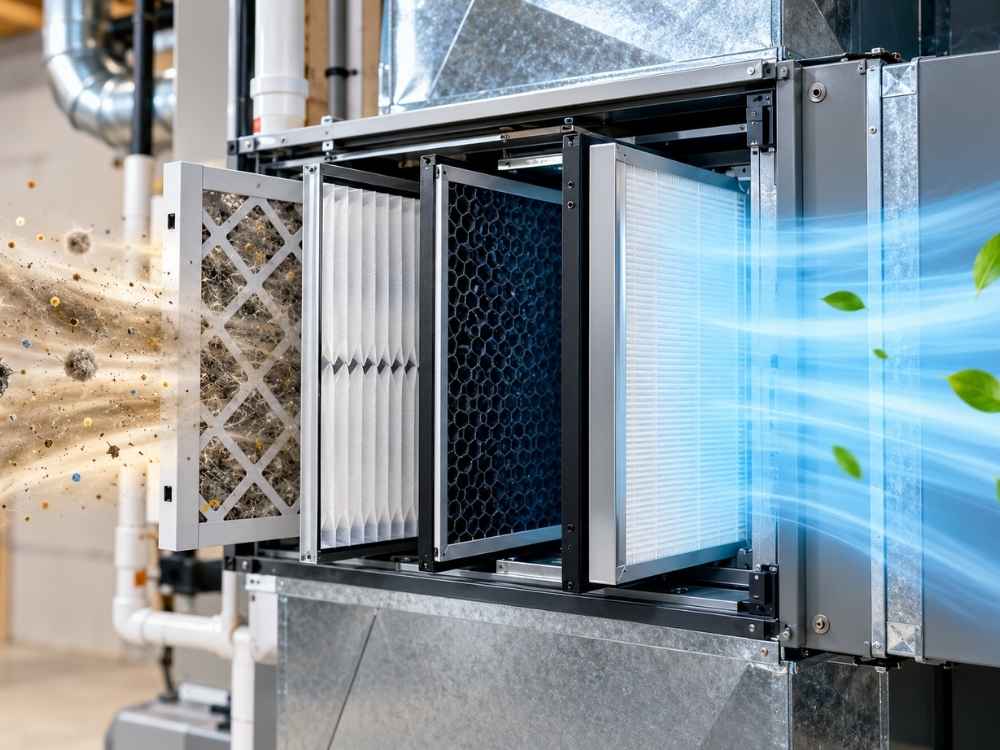
Advanced filtration systems are technologies designed to capture airborne particles and, depending on the filter type, certain gases and odors as air moves through a heating, ventilation, and air conditioning (HVAC) system or a dedicated air-cleaning device.
Unlike basic filters that primarily protect HVAC equipment from larger debris, more advanced filtration options can capture a wider range of airborne particles. These may include dust, pollen, pet dander, fine particulate matter, and some mold spores. Specialized filters can also help reduce certain gaseous pollutants.
Indoor air quality matters because people spend a significant amount of time inside homes, offices, schools, and commercial buildings. Everyday activities such as cooking, cleaning, using household products, and bringing in outdoor air can introduce pollutants into indoor spaces.
Advanced filtration systems can help reduce some of these contaminants when the equipment is appropriately selected, installed, and maintained. However, filtration works best alongside proper ventilation and measures that reduce pollutants at their source. US EPA+1
Why Is Indoor Air Quality Important?
Indoor air quality affects the comfort and usability of a building. Dust accumulation, lingering odors, airborne particles, and inadequate ventilation can all contribute to an uncomfortable indoor environment.
Several common sources can affect indoor air quality:
- Dust and debris: Everyday movement, furnishings, and household activities release particles into the air.
- Pollen and outdoor allergens: Particles can enter through doors, windows, and ventilation systems.
- Pet dander: Small particles from pets can circulate through indoor spaces.
- Cooking and cleaning: These activities may release particles, odors, and other airborne pollutants.
- Mold spores: Damp materials and moisture problems can contribute to mold growth and airborne spores.
- Fine particulate matter: Smoke and other combustion sources can introduce particles that are difficult to capture with basic filters.
A properly designed filtration system helps capture particles that pass through it. It cannot eliminate every contaminant, resolve an underlying moisture problem, or replace fresh-air ventilation.
For homeowners and property managers, improving indoor air quality starts with identifying the primary concern and selecting a practical combination of filtration, ventilation, cleaning, and source control.
7 Benefits of Advanced Filtration Systems
1. Better Control of Airborne Dust and Particles
One of the main advantages of advanced filtration systems is their ability to capture airborne particles as air passes through the filter.
Depending on the filter’s efficiency, design, and condition, these systems may capture:
- Household dust and fine debris
- Pollen and other outdoor particles
- Pet dander
- Some mold spores
- Smaller airborne particulate matter
Reducing airborne particles can help limit the amount of material circulating through a building. It may also reduce the rate at which dust accumulates on some surfaces, although regular cleaning remains necessary.
For the best results, choose a filter suited to the pollutants you want to address and the airflow requirements of your HVAC equipment.
2. Support for a More Comfortable Indoor Environment
An indoor environment should feel comfortable, not dusty or stale. Advanced filtration systems can contribute to a cleaner-feeling space by capturing some of the particles that circulate through heating and cooling equipment.
This can be particularly useful in homes with pets, buildings near busy roads, and properties where outdoor dust or seasonal pollen is a concern.
Filtration is only one part of indoor comfort, however. Temperature control, humidity management, ventilation, and routine cleaning also influence how an indoor space feels.
If a room continues to feel stuffy or has persistent odors despite regular filter replacement, the underlying issue may involve insufficient ventilation, excess moisture, or a pollutant source that filtration alone cannot address.
3. Improved Management of Seasonal Allergens
Pollen levels can rise during spring, summer, and other seasonal periods. When these particles enter a building, they may circulate through its indoor spaces.
Advanced filtration systems with appropriate particle-capture performance can help reduce airborne pollen and some other allergens that pass through the filter.
Homeowners considering a filtration upgrade should pay attention to:
- The filter’s rated particle-capture efficiency
- Whether the filter fits the existing equipment
- Airflow requirements and system compatibility
- The frequency of filter replacement
- Whether additional room air cleaners would be beneficial
A central HVAC filter only treats air that passes through the system. A portable air cleaner may provide additional filtration in a frequently occupied room if it is correctly sized.
Filtration may help reduce airborne allergen exposure, but it does not guarantee allergy symptom relief or eliminate allergens that have settled on bedding, carpets, and furniture. US EPA+1
4. Potential Support for HVAC Equipment Performance
Air filters play an important role in protecting HVAC components from dust and debris. When the correct filter is installed and maintained, it can help limit unwanted material from accumulating on internal surfaces.
However, choosing a filter with the highest possible rating is not always the best solution. A filter that creates excessive resistance to airflow can interfere with equipment operation if the system was not designed to accommodate it.
A suitable advanced filtration system should balance particle removal with the airflow requirements of the furnace, air conditioner, or heat pump.
Professional assessment can help determine whether an existing system can accommodate a higher-efficiency filter or whether modifications are necessary.
5. Assistance With Certain Odors and Gaseous Pollutants
Not all indoor pollutants are particles. Cooking smells, some household chemical emissions, and certain volatile organic compounds (VOCs) are gaseous contaminants.
Standard particle filters are generally not designed to remove these gases effectively. Activated carbon and other specialized sorbent materials may help capture certain odors and gaseous pollutants, depending on the material, quantity, and specific contaminant.
When choosing a filtration solution for odor control, consider the following:
- Identify the source of the odor whenever possible.
- Check whether the filter is designed for the specific gas or odor.
- Look for information about the filtration media and its expected service life.
- Replace saturated or exhausted media according to manufacturer instructions.
- Improve ventilation when appropriate and safe to do so.
An odor-control filter should not be treated as a substitute for repairing a gas leak, correcting a combustion problem, or removing a source of chemical contamination. US EPA+1
6. Flexible Solutions for Different Buildings
Advanced filtration systems are not limited to one type of property. Different solutions can be selected according to building size, occupancy, equipment design, and indoor air concerns.
For example, a home may benefit from an upgraded furnace filter, while a commercial property with specific air-quality requirements may need a more comprehensive filtration and ventilation assessment.
Possible solutions include:
- High-efficiency pleated filters: Designed to capture more particles than many basic panel filters.
- HEPA air cleaners: Used in compatible equipment or dedicated air-cleaning units for high-efficiency particle removal.
- Activated carbon filters: Intended to capture certain gases and odors.
- Portable air cleaners: Provide localized filtration in individual rooms or occupied areas.
- Multistage filtration: Combines different filter types to address multiple categories of contaminants.
The right choice depends on the application. Not every building needs every technology, and not every advanced filter is compatible with every HVAC system.
7. A More Practical Approach to Long-Term Indoor Air Management
Installing a filtration upgrade can be a useful step toward better indoor air management, but its performance depends on ongoing maintenance.
A well-planned system makes it easier to monitor filter condition, schedule replacements, and identify problems before they affect airflow or indoor comfort.
Property owners can benefit from a simple maintenance routine that includes:
- Checking filters regularly for visible dirt and blockage.
- Following the manufacturer’s replacement schedule.
- Inspecting filter housings for gaps that allow air to bypass the filter.
- Scheduling HVAC maintenance as recommended.
- Investigating persistent dust, odors, or airflow problems.
- Addressing leaks, dampness, and other pollutant sources promptly.
This approach helps keep filtration equipment working as intended and reduces the risk of relying on a neglected filter to solve an indoor air quality problem.
What Types of Advanced Filtration Systems Are Available?
Understanding the main filtration options makes it easier to select a solution that matches your indoor air quality goals.
High-Efficiency Pleated Air Filters
Pleated filters use folded filter media to provide a larger surface area for capturing particles. Many models offer better filtration than basic flat-panel filters.
Their efficiency varies by rating and design. They are often a practical starting point for homeowners who want to improve particle removal without replacing their entire HVAC system.
HEPA Filtration Systems
High-Efficiency Particulate Air (HEPA) filters are designed to capture at least 99.97% of particles measuring 0.3 microns under the applicable test conditions. They are commonly used in dedicated air cleaners.
Because HEPA filters can create substantial airflow resistance, they should not automatically be installed in a standard residential HVAC system without checking compatibility.
Activated Carbon Filtration
Activated carbon filters use adsorptive material to capture certain gases and odors. They can complement particle filtration when odor or gaseous pollutant control is a priority.
Their effectiveness depends on the pollutant, the quantity of carbon, and the amount of air passing through the filter.
Multistage Filtration
Multistage systems combine different filtration methods to address different contaminants. For instance, a system might use a particle filter alongside activated carbon media.
The advantage is that each stage can serve a specific purpose. However, the complete system must be designed to maintain suitable airflow and provide the intended filtration performance. US EPA+1
How Do You Choose the Right HVAC Filtration System?
Selecting advanced filtration systems requires more than choosing a filter with an impressive rating. The best option must match the building, HVAC equipment, and specific air quality concerns.
Consider these factors before making a decision.
1. Check the MERV rating. Minimum Efficiency Reporting Value (MERV) indicates how effectively a filter captures particles of different sizes under standardized testing. Higher ratings generally indicate greater particle-capture efficiency. MERV 13 may be a useful target where the HVAC system can accommodate it, but equipment compatibility must be confirmed. US EPA+1
2. Confirm the correct filter size. A filter should fit securely in its designated housing. Incorrect sizing can allow unfiltered air to bypass the filter.
3. Evaluate airflow requirements. A filter that is too restrictive for the system can reduce airflow and affect performance. Check the equipment manufacturer’s recommendations before upgrading.
4. Identify your main concern. Dust, pollen, odors, and gaseous pollutants may require different filtration approaches. Determine which problem you want to address first.
5. Consider operating costs. Compare replacement filter prices, expected service life, maintenance requirements, and any additional energy use associated with the selected equipment.
6. Seek professional guidance. An HVAC professional can assess the existing equipment and recommend a suitable filtration solution without compromising system operation.
Why Is Regular Filtration System Maintenance Essential?
Even high-quality filtration equipment needs regular attention. As particles accumulate, a filter can become dirty and restrict airflow. The appropriate replacement interval depends on the filter type, manufacturer’s guidance, system usage, and indoor pollution levels.
For example, homes with pets, ongoing renovations, or heavy dust exposure may need more frequent inspections than homes with lower particle levels.
Follow these practical maintenance steps:
- Inspect the filter at the intervals recommended by the manufacturer.
- Replace disposable filters when required rather than waiting for severe blockage.
- Clean reusable filters only according to their instructions.
- Check that the filter is installed in the correct direction.
- Keep supply and return vents unobstructed.
- Schedule routine HVAC inspections to identify airflow or equipment issues.
Avoid assuming that every filter should be replaced on the same schedule. Some require attention more frequently than others, so the manufacturer’s instructions should remain your primary guide. US EPA+1
How Can Refresh PMS Help With Your Indoor Air Quality Goals?
Choosing the right filtration solution is easier when you understand how it fits into your overall heating and cooling system. Equipment compatibility, airflow, maintenance needs, and the source of indoor pollutants all influence the best approach.
At Refresh PMS, homeowners can explore HVAC-related solutions and maintenance considerations as part of their efforts to maintain comfortable, functional indoor spaces. If you are considering an upgrade, discuss your existing equipment, current air quality concerns, and maintenance needs with a qualified professional before selecting a filtration system.
A practical assessment can help determine whether an upgraded HVAC filter, a dedicated air cleaner, additional ventilation, or a combination of measures is the most appropriate option for your property.
Common Mistakes to Avoid With Advanced Filtration Systems
Even a well-designed filtration system can underperform if it is selected or maintained incorrectly.
Avoid these common mistakes:
- Choosing a filter based on rating alone: Higher efficiency does not guarantee compatibility with existing HVAC equipment.
- Ignoring ventilation: Filtration does not replace the need for appropriate fresh-air exchange.
- Neglecting pollutant sources: Moisture problems, smoke, and chemical emissions may require direct intervention.
- Forgetting filter replacement: Dirty filters can reduce airflow and filtration performance.
- Expecting complete purification: No single filter removes every particle, gas, and contaminant.
- Using unsuitable air-cleaning technologies: Avoid ozone-generating air cleaners in occupied spaces because ozone can irritate the respiratory system. US EPA+1
Frequently Asked Questions
Q. What are advanced filtration systems used for?
A. Advanced filtration systems help capture airborne particles such as dust, pollen, pet dander, and certain fine particles. Specialized filtration media may also reduce particular odors and gases.
Q. Is a higher MERV rating always better?
A. No. Higher MERV ratings generally indicate better particle capture, but the filter must be compatible with the HVAC system’s airflow requirements. Consult the equipment manufacturer or an HVAC professional before upgrading.
Q. How often should advanced air filters be replaced?
A. Replacement frequency depends on the filter type, manufacturer recommendations, system usage, and indoor pollution levels. Inspect filters regularly and replace them according to the manufacturer’s instructions.
Q. Can advanced filtration systems eliminate all indoor air pollutants?
A. No. Filtration can reduce certain airborne contaminants, but it cannot eliminate every pollutant. Effective indoor air management also involves source control, suitable ventilation, moisture management, and regular HVAC maintenance.
Conclusion
Advanced filtration systems can play an important role in improving indoor air quality by capturing airborne particles and, with suitable specialized media, addressing certain odors and gases. From high-efficiency pleated filters to HEPA air cleaners and multistage systems, several options are available for different properties and air quality concerns.
The most effective solution is one that balances filtration performance, equipment compatibility, airflow, and ongoing maintenance. Before investing in an upgrade, identify your primary indoor air concerns and confirm which filtration options your HVAC system can support.
With the right selection and regular maintenance, homeowners can make more informed decisions about cleaner indoor air and long-term HVAC performance. Refresh PMS can be a starting point for exploring HVAC-related needs and determining which questions to discuss with a qualified professional.